How can you make Flash USDT using the working method
Flash USDT is a concept of creating a USDT-like token instantly using a smart contract deployment and interaction workflow primarily on the Ethereum network. This method focuses on educational and testing purposes and involves using tools like ChainIDE and MetaMask to simulate the creation and management of a flash USDT token.
Flash USDT creation involves writing an ERC20 token smart contract that represents USDT or a similar stablecoin. Developers use ChainIDE, an online integrated development environment for blockchain, to write, compile, and deploy the smart contract code. MetaMask, a popular Ethereum wallet extension, is then connected to interact with the deployed contract, enabling token management and transfer functionalities.
The full process includes setting up the ChainIDE environment, coding the ERC20 token structure compatible with USDT standards, deploying the contract on a test or Ethereum network, and verifying the contract's functionality through MetaMask wallet interaction. This approach enables users to understand the token creation workflow and the interaction between decentralized applications and wallets.
What is Flash USDT and how does it work
Flash USDT refers to the quick generation of a USDT-like ERC20 token using smart contract deployment techniques. The token mimics the behavior of Tether (USDT) on Ethereum but is created instantly through custom code. This token is not official USDT but rather a flash token created for testing, educational, or development usage.
The working principle is based on smart contracts written in Solidity that define token supply, transfer functions, and wallet balances. Once deployed via ChainIDE, the token contract can be accessed and managed through MetaMask, allowing users to simulate transactions and token distribution.
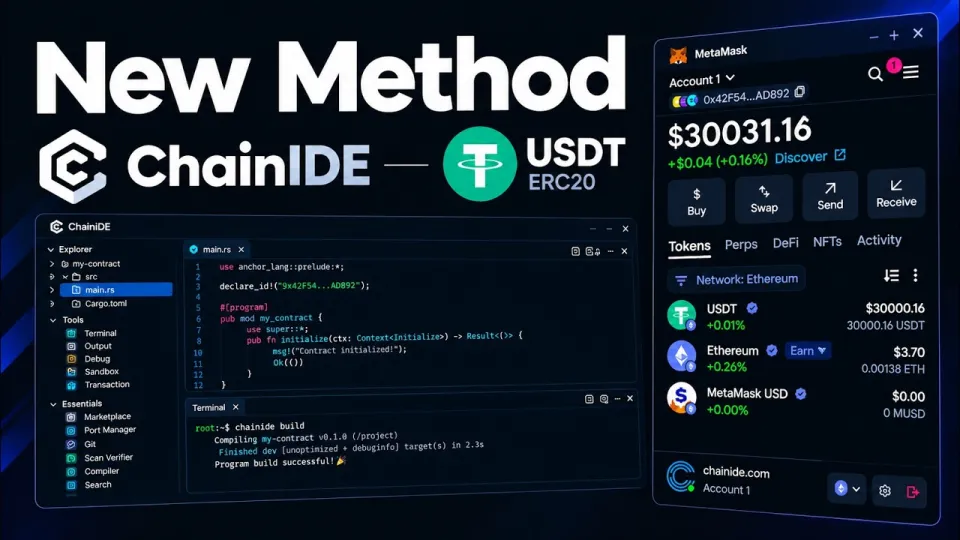
Video: How to Make Flash USDT | Working Method 2026
Setting up ChainIDE for Flash USDT creation
ChainIDE is an online development environment designed for smart contract development. To create Flash USDT:
- Open ChainIDE and create a new Solidity project.
- Write or import the ERC20 token contract code designed to replicate USDT functionality.
- Compile the contract using the provided compiler in ChainIDE.
- Configure deployment parameters such as initial supply and contract name.
- Deploy the contract to the Ethereum test network or mainnet if applicable.
This setup allows developers to manage contract code efficiently and test deployments without needing local blockchain nodes.
Connecting and interacting with MetaMask
MetaMask is a browser extension wallet that connects to Ethereum networks and allows users to manage tokens and sign transactions. After deploying the Flash USDT contract:
- Connect MetaMask to the same Ethereum network where the contract is deployed.
- Add the Flash USDT token contract address to MetaMask as a custom token.
- Use MetaMask to send token transactions, approve spending, and check balances.
This interaction demonstrates how decentralized applications (dApps) communicate with wallets to facilitate token management.
Understanding the ERC20 token structure for Flash USDT
The ERC20 token standard defines a common interface for tokens on Ethereum. Key components of the Flash USDT token contract include:
- totalSupply: The total amount of tokens created.
- balanceOf: Function to check token balance of an address.
- transfer: Function to send tokens to another address.
- approve and transferFrom: Functions to allow delegated token transfers.
The Flash USDT contract is coded to follow these standards closely, ensuring compatibility with wallets and exchanges that support ERC20 tokens.
Testing and verifying the Flash USDT setup
Before any real usage, testing the Flash USDT contract is essential:
- Use Ethereum test networks (like Ropsten, Rinkeby) to deploy and interact with the contract.
- Verify that token transfers update balances correctly.
- Check for common mistakes such as incorrect address inputs or insufficient gas fees.
- Review the smart contract code for security and logic errors.
This verification process helps prevent losses and ensures that the Flash USDT token behaves as expected.
Common mistakes and precautions
When working with Flash USDT creation:
- Never send real funds to unverified or unknown contracts.
- Always confirm contract addresses and source code before interacting.
- Be cautious with network selection (testnet vs mainnet).
- Understand that Flash USDT tokens are not official USDT and have no real monetary value.
These precautions are necessary to avoid scams, losses, and unintended transactions.
Useful links
- Official Flash USDT method and ChainIDE script: https://sites.google.com/view/defiflashusdt
Conclusion
Creating Flash USDT involves deploying an ERC20 token contract using ChainIDE and managing it through MetaMask. This method provides an educational and development-focused workflow to understand token creation, contract deployment, and wallet interaction on Ethereum. It is crucial to treat this method as a testing tool and avoid real fund transactions with unverified contracts. For comprehensive guidance and the working script, visit the official Flash USDT page at https://sites.google.com/view/defiflashusdt. This article is based on the detailed walkthrough provided by the Rca FastPrint channel, which offers valuable insights into blockchain development and DeFi tutorials.
Key takeaways
- Flash USDT is created via smart contracts on Ethereum using ChainIDE and MetaMask.
- The process involves writing and deploying an ERC20 token contract mimicking USDT.
- ChainIDE provides the development environment, MetaMask handles wallet interactions.
- Testing and verifying contracts is crucial before any real transactions.
- The method is for educational and development purposes only, not for real funds.
Questions & answers
What is Flash USDT?
Flash USDT is a quickly created ERC20 token that mimics the USDT stablecoin functionality, primarily for educational and testing purposes using smart contracts.
Which tools are needed to create Flash USDT?
The main tools are ChainIDE for smart contract development and deployment, and MetaMask for wallet interaction and token management.
Is Flash USDT real USDT?
No, Flash USDT is a custom token created via smart contracts and is not official USDT. It holds no real monetary value and is intended for development and testing only.
Can I use Flash USDT for real transactions?
It is not recommended to use Flash USDT for real transactions or send real funds to unknown contracts. Always verify contract details and use test networks for experimentation.
Source: How to Make Flash USDT | Working Method 2026 · Markdown version